Artificial Intelligence and the Collapse of the Gold Standard
● English translation below — also as PDF or markdown
Writing is the beating heart of our society. The primary tool for communication and memory preservation, it has above all been, for centuries, the main instrument for selecting our elites. From essays to civil service exams, we have built our identity and our educational system on the mastery of this skill, considering it the classic expression of intelligence.
However, the emergence of generative Artificial Intelligence inflicts a profound narcissistic wound upon us today. AI reveals an uncomfortable truth: this linguistic know-how, which we believed inaccessible to machines, ultimately fits into a few mathematical matrices. As mathematician Terence Tao1 suggests, our traditional definition of intelligence is collapsing.
Should we therefore see the machine as a conscious creator? No. AI is not a spontaneous creator acting ex nihilo. The very idea of human creation emerging from nothingness, although elevated to a dogma by the Renaissance and Romanticism (founding our modern copyright along the way), remains historically contingent; in Antiquity, the poet was merely a vessel channeling the inspiration of the Muses. AI reminds us of this reality: it operates as a cognitive exoskeleton, a machine for compressing and recombining human doxa. In information theory, Kolmogorov complexity3 measures the minimum amount of instructions needed to reproduce an object. By managing to compress almost all of our linguistic expertise into a few gigabytes, AI models make us realize that the shaping of language was ultimately not of such great algorithmic complexity. Writing is fundamentally just an information decompression process4. What school rewarded was therefore often merely a "mechanical virtuosity" (the deployment of syntax, register, transitions), which is now entirely modelable. This formal mastery was fundamentally just a convenient proxy: a measure that historically correlated with intelligence or critical thinking, without being synonymous with them.
The collapse of the gold standard and "AI slop"
The field of patents illustrates this perfectly: AIs (like those from the startup Qatent) now co-write texts that satisfy legal requirements. But the method is unsettling: rather than a flash of genius, the algorithm models technical knowledge into a vast multidimensional map ("latent space"). Each idea corresponds to a precise point in it.
Inventing then simply amounts to calculating a trajectory towards an empty coordinate, an unexploited "hollow" in this space. Inventive activity suddenly becomes a metric. The philosophical question "is it creative?" becomes a geometric question: "at what mathematical distance is this empty space located from existing knowledge?".
Since the machine is capable of automatically navigating this model to generate combinations, the human's role shifts: from absolute creator, they become a curator, the one who gives the editorial direction and chooses which mathematical void deserves to be explored. The act of writing and inventing now resembles what Jorge Luis Borges had masterfully foreseen. Aware of the finitude of the combinatorial space of possibilities, he apologized to his reader for "the discourtesy of having usurped" their own verses first2. Formal creation would ultimately be just a vast mathematical interpolation of known data. While engineering closes the debate on the machine's "combinatorial" innovation, the mystery of true invention—the cognitive leap or extrapolation out of distribution—remains the unsolved problem of AI.

The pedagogical consequence of this shift is radical: it is the collapse of the gold standard. The "homework assignment" as we know it, which assessed the student's ability to produce a coherent text, is dead. The written product is no longer, in itself, proof of a thought. However, history teaches us that faced with a democratizing technology (like the printing press), educational hierarchies do not collapse: they simply shift their criteria. Especially since this upheaval is also a fantastic opportunity for inclusion: for students hindered by form (learning disabilities like dyslexia, sociolinguistic barriers), AI acts as a liberating prosthesis that finally equalizes the chances of participating in the debate of ideas. By leveling formal mastery in this way, the machine makes the redefinition of the standard all the more indispensable and urgent. The question then becomes: what will our new selection criterion be?
More broadly, this industrialization floods society with formally correct but featureless "AI slop". The insidious risk of this deluge is the radical personalization of information: with texts generated custom-made for each reader, we risk the end of a common culture and shared references.
The historical pivot: writing becomes a "sport"
But history has already placed us in the face of such a rupture. Faced with this dispossession, history reminds us of precedents. The invention of the tractor made muscular strength obsolete for survival, but this strength was then sublimated to codify modern sport5. Later, the calculator trivialized the virtuosity of mental calculation, relieving mathematics education of a mechanical burden to allow it to fully refocus on what has always been its core: abstraction.
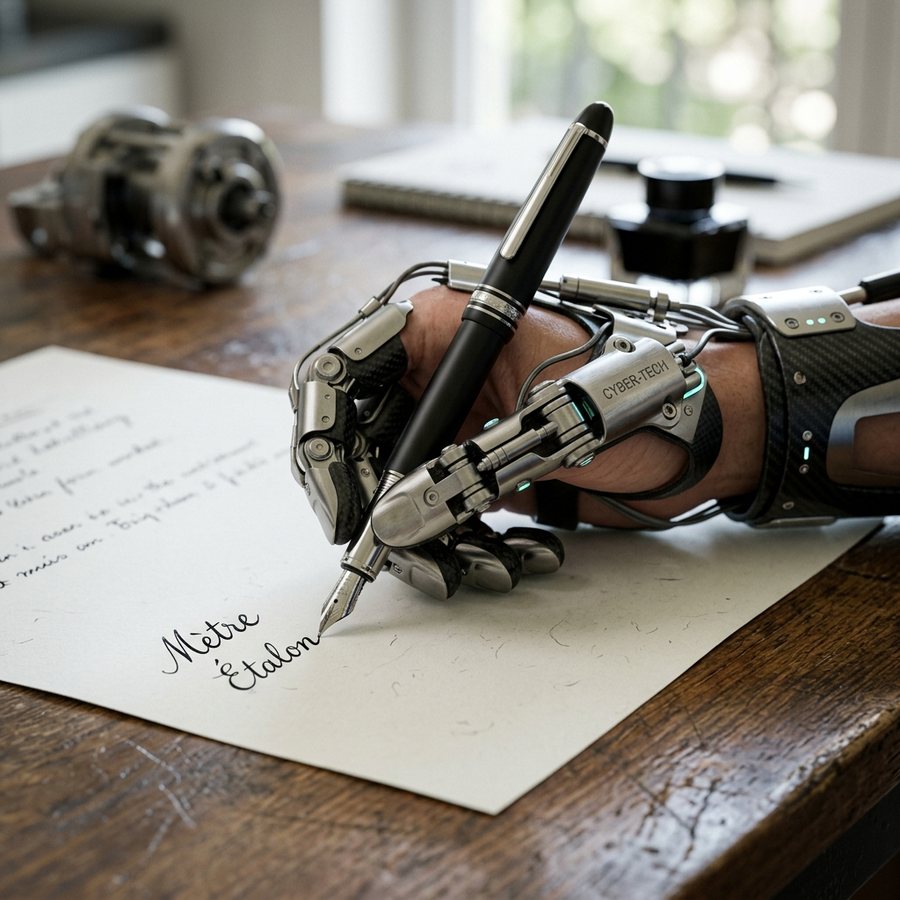
Grammatical mastery and the canonical structuring of discourse constitute our modern calligraphy. This "calligraphy of the mind" has just been officially delegated to the machine. Freed from its strict utilitarian function of volume production, "unassisted" human writing will not disappear, but it is destined to become an intellectual sport, a cognitive gymnastics practiced to structure the brain and for the beauty of the gesture.
The new mission of the school: seeking the human anomaly
In this new paradigm, school faces a dual mandate. On the one hand, to establish "AI-free bunkers" (offline environments) to train students' brains in this essential cognitive sport. On the other hand, to teach the use of the machine everywhere else for production writing.
Since the generative algorithm samples probabilities, it produces a textual surface so smooth and coherent that it gives the convincing illusion of a conscious interlocutor—this is the famous "Eliza effect"6 (this human propensity to attribute a soul and an intention to the machine). This anthropomorphic mirage makes us find meaning even when the AI goes factually off track (its "hallucinations"). Faced with this illusion, the school can no longer evaluate only the form of the text. The urgency is to refocus on anchoring to reality, discernment, and fact-checking.
Finally, if the machine writes with such efficiency, why do we suddenly reject a perfect poem with disgust as soon as we discover a posteriori that it was generated by AI? It is the shock of the pragmatic imposture: in linguistics (according to Grice's maxims7), communication rests on a tacit pact of cooperation with an intentional speaker. Although the machine's text is formally irreproachable, its value collapses in the face of the absence of a true enunciating subject, because we seek above all the guarantee of a lived emotion and not the imitation of a statistical probability. In a world flooded with standardized texts, the true excellence of tomorrow—the one that school will have to cultivate—will consist in teaching students to seek their singularity, their human "anomaly".

A dizzying question remains. Historically, school "bunkers" always end up yielding to social practices. Isolating oneself from AI is perhaps only a transitional solution, time to understand what tomorrow's world will really need. This is an unprecedented situation: will we be able to maintain and educate our intellect without artificially protecting ourselves from machines designed to think for us? Even more radically, will the educational institution itself survive a society that, paradoxically, might need fewer humans to "think"?
- Castelvecchi, D., ‘The job description is changing’: mathematician Terence Tao on the rise of AI, Nature, April 27, 2026. [online] ↩
- Borges, J. L., "A quien leyere" (Preface), Fervor de Buenos Aires, Imprenta Serantes, 1923. ↩
- Strictly speaking, Kolmogorov complexity is incomputable. Here it refers to the theoretical horizon of a massive probabilistic statistical compression phenomenon, empirically demonstrating that the syntactic "surface" of language is highly compressible. ↩
- If AI excels in the referential function of language (transmitting information), it is its fundamental inability to assume the expressive and phatic functions (Jakobson) that will feed the paradox of the imposture that we mention later. ↩
- While physical competition has always existed, industrialization definitively relegated muscular strength from an economic necessity of survival to a predominantly recreational and aesthetic practice. ↩
- Weizenbaum, J., Computer Power and Human Reason: From Judgment to Calculation, W. H. Freeman, 1976. Weizenbaum, creator of the ELIZA program (1966), was the first to describe and be alarmed by this human tendency to attribute consciousness to a purely mechanical system. ↩
- Grice, H. P., "Logic and Conversation", in P. Cole & J. Morgan (eds.), Syntax and Semantics, vol. 3, Academic Press, 1975, pp. 41–58. ↩